SHOP BOARD — FLOWS POSTED WHEN THE GAUGES REPORTFREE U.S. SHIPPING OVER $49 · SHOP STATUS: OPEN — CLOSED WHEN THE WATER'S RIGHT
When to change flies
flies-bugs-hatches

When to change flies

Drew··5 min read

Change the fly when a fish came, looked and turned away. If nothing moved at all, change your lane or depth instead — and if the water is in the low forties, change nothing, because a trout that cold feeds once, at night.

Take the water temperature before you take the fly off. When you do change, go one size down and stay near what they're already eating: trout feed in a narrow size band and need days, not drifts, to accept anything unfamiliar.

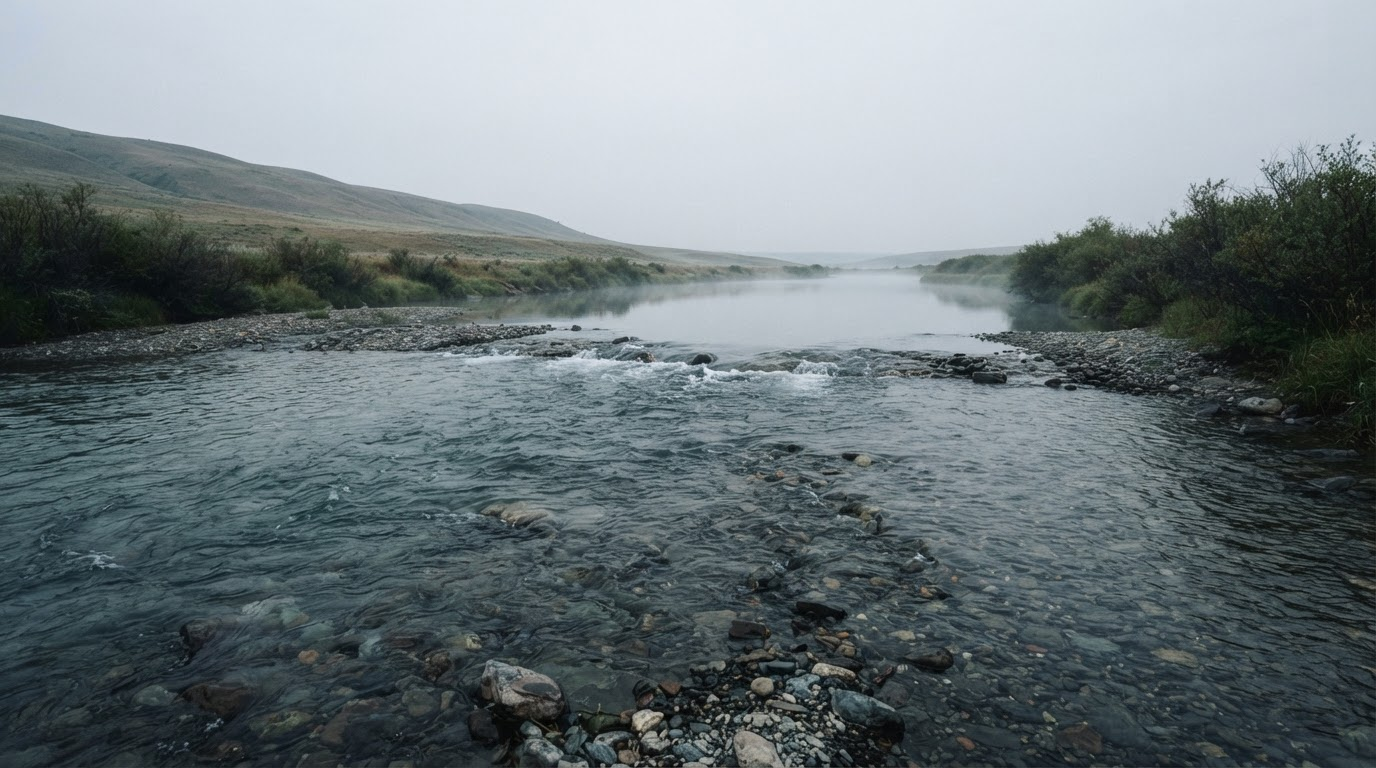
It's early spring, the water's in the low forties, and you have the run to yourself. You're doing everything right — good depth, clean mends, a drift with no drag on it. Nothing.

So you start changing. Pheasant tail. Smaller pheasant tail. Jig with a hot spot. Something with more flash, then something with less. Forty minutes and six flies later you're standing in the same water getting the same result, and you leave for lunch sure you don't own the right fly.

You come back around two, with four hours of sun on the water. Second drift, on the fly you tied at first light, a fish eats. Then another.

Nothing about the fly changed. The water came up four degrees.

Almost everyone reads a blank hour the same way: the fly is the one variable you can change with your hands, so the fly is what must be wrong.

It sounds right, and on a cold morning it is the most expensive thing you can believe. Whether a trout is eating at all gets settled before any of that.

when it's time to change flies

Every answer you've been handed comes in one of two shapes: fix the drift before you fix the fly, and change after some number of casts. The number is where it comes apart. Ask a room full of guides and you get nine guides, nine different thresholds, running from three or four casts to thirty or forty minutes. The more careful version is to fish the fly effectively first, which is right as far as it goes, but it still puts the pattern on trial.

Underneath all of it is a question about the fish, not the fly. Water temperature sets how fast a trout empties its stomach, and that sets how many meals it takes in a day. In a mountain stream holding both brown and rainbow trout, at mean temperatures of 4.7°C and 7.3°C — roughly 40 to 45°F — there was one night-time feeding window at 4.7°C, in the early hours of darkness, and what the fish took in barely covered the cost of existing.

Warm the same water and the day changes shape. At 10.8°C, call it the low fifties, a second daytime window at 10.8°C appeared — and now there's a fish on the clock while you're standing in the river.

So a cold morning is not a pattern problem. You can put the whole box down a good seam and it won't matter, because the trout you're presenting to isn't scheduled to eat until long after you've driven home. Water temperature answers that in ten seconds. Six fly changes answer nothing, and the forty minutes they cost you is forty minutes of the warming you were waiting on.

That leaves the sessions where the water is warm enough and something should be feeding. Then the fly is fair game — but only if you can read what actually happened on your last drift.

what the decision looks like on the water

The two branches on the right-hand side are the ones that decide whether the pattern is on trial at all.

how do I know if the fish even saw it?

Two different things happen when a trout doesn't eat, and they don't take the same fix. Either nothing moved, or something moved and turned away.

Trout aren't out there hunting for novelty. Watching cutthroat trout in a stream for ten days, water velocity was the main cue they used to choose where to feed — not what happened to be floating in it — and they were not thorough searchers. Food put a few metres off a fish's normal feeding position didn't reliably get found. A trout is a creature of one lane. If your fly went down a lane it isn't working, or a foot over its head, nobody rejected anything. It never got assessed.

This is where the standard sequence gets applied too widely. Common advice is to change nymphs after 10–20 casts without attention, giving an ignored fly and a refused fly the same remedy. The dry-fly version is tighter — kill the drag, drop a size, then change pattern, then rest the pool half an hour — and it works because a visible refusal is real information. The fish came, looked, and turned. Size, silhouette, or drag you can't see from where you're standing.

Ignored is a lane-and-depth problem: move your feet, get deeper, put the drift on the seam instead of beside it. Refused is a fly problem. Jim McLennan's framing is the one worth keeping — five or ten genuinely good casts beat the same bad one 250 times, and repositioning counts as changing something.

A fish that came up, looked, and turned away has earned you a fly change. What you reach for next is where most boxes let you down.

Get letters like this in your inbox

This Week's Path — one skill, one water-finding trick, one first-fish story. Tuesdays.

so what do I change to?

Smaller than you think, and closer to what they're already eating than you'd like. The size band trout actually feed in is tighter than the band your box covers. Across 288 brown trout and 15,131 prey items sampled from wadeable riffle sections, 4–6 mm was eaten most often, with the bulk of everything between two and six millimetres. In hook terms that's an 18 or a 20 — a small mayfly nymph, a midge pupa, a bare-looking caddis larva.

The big stuff wasn't missing from the river, either. Invertebrates over 10 mm were rarer in stomachs than they were in the drift or on the streambed. It was right there in front of them, and it was getting passed.

The other half of this is that unfamiliar food is slow to catch on. Trout work off a mental template of what food looks like, and updating it takes time. In experimental pools, naive brook trout took seven days to accept novel prey, against under a day when one fish that already knew the item was in with them. That's the machinery behind something you've watched a hundred times: nothing, nothing, nothing, then one fish eats and three more follow. If the fly you tie on sits well outside what they're on, drift twenty-five isn't converting anybody. Change in short steps — a size down, a shade darker, a slimmer profile.

And when you go looking for the answer, look in the water column. Trout diet matched the drift, not the benthos. Turning over rocks samples the wrong crowd.

None of that explains the pool that gave you two fish in ten minutes and then went dead with the same fly on. That one isn't about the pattern either.

try this on your next slow hour

Before you open the box, find out what the water is doing. Take a temperature if you carry a thermometer; if you don't, use your hand, the calendar, and how long the sun has been on the run. Then write down two things when a fish finally eats: the time, and how cold the water felt. Do that four or five times on the same stretch and you'll know when your water switches on — which is worth more than any pattern you could have tied on instead.

A few things come up every time this conversation happens on the gravel.

questions people ask about this

A pool gave me two fish and then went quiet. Is the fly done?

Maybe not. In small waters fished hard with every fish released, catch rates fell within 7–10 days while the number of fish stayed the same. The model that fit the data needed both learning and a highly catchable subgroup — the willing fish come out first, then they stop cooperating. A quiet pool can mean the willing ones are already accounted for, and a fly change there is really a way of putting the question to a different fish.

How many casts should I give a fly?

Enough good ones to know it was seen in the lane you think the fish is holding in. Cast count is a stand-in for coverage, which is why every published number is different.

Should I fish a bigger fly if I want a bigger fish?

Nothing holds that up. Mean prey size showed no increase with fish length — the longer trout in those riffles weren't eating bigger insects than the small ones.

There are bugs in the air and nothing's working.

What's visible above the water doesn't have to match what works under it, since plenty of what trout eat never surfaces: what's hatching needn't match your nymph.

The short version

Cold water means one meal a day
At mean water temperatures of 4.7°C and 7.3°C (roughly 40–45°F), stream brown and rainbow trout fed in a single window in the early hours of night. A daytime feeding window only appeared at 10.8°C.
Ignored and refused are different events
Nothing moved means the fly was never assessed — that's a lane and depth problem. A fish that came, looked and turned away assessed it and said no. Only the second one is a fly problem.
The size trout actually eat
Across 288 brown trout and 15,131 prey items, 4–6 mm was the most commonly eaten prey size, with the bulk between 2 and 6 mm. That's a size 18 or 20.
Big bugs are available and passed
Invertebrates over 10 mm were more frequent in the drift and on the streambed than in trout stomachs, and mean prey size showed no significant increase with fish length.
Unfamiliar flies aren't figured out in a session
Naive brook trout took 7 days to feed heavily on a novel food item, versus under a day when one fish that already recognised it was present.
Turning rocks samples the wrong crowd
Trout diet matched the percentage composition of the drift, not the benthos. What's clinging to the streambed isn't what's being eaten.

Sources

  1. Feeding chronology and diet of brown and rainbow trout in a Pyrenean mountain stream[study]At mean temperatures of 4.7°C and 7.3°C the only feeding period was the early hours of night, with intake near resting-metabolism needs; a second daytime feeding period appeared at 10.8°C; diet matched the drift, not the benthos.
  2. Foraging site selection and search behaviour in stream-dwelling cutthroat trout[study]Water velocity was the main physical cue used to select foraging positions; fish were not perfect searchers and did not reliably locate new food a few metres from their normal feeding position.
  3. Search image formation and social learning of novel prey in brook trout[study]Naive fish took 7 days to feed heavily on a novel prey item, versus under 1 day when a trained fish was present.
  4. Prey size selection by brown trout in eight NW Spanish rivers[study]4–6 mm was the most commonly consumed prey size across 288 brown trout and 15,131 prey items; invertebrates over 10 mm were more frequent in benthos and drift than in the diet; mean prey size showed no significant increase with fish length.
  5. Angling-induced changes in catchability of rainbow trout in small lakes[study]Sustained catch-and-release angling dropped catch rates within 7–10 days while fish numbers stayed constant; the best model required both learning and a highly catchable subgroup.
  6. Troutbitten: When Should You Change the Fly?[industry]Fish the fly you have on effectively — refine drift and angle — before changing pattern.
  7. Orvis: Ask the Experts — How Do You Know When It's Time to Change Flies?[industry]Nine guides give nine different thresholds, from 3–4 casts to 30–40 minutes.
  8. Anchored Outdoors: When Should I Change Flies? — Jim McLennan[industry]Make five or ten genuinely good casts rather than the same bad one 250 times; repositioning counts as changing something.
  9. Troutbitten: Confidence Flies, Signals and Changes[industry]What's visible on the surface or in the air doesn't necessarily correlate with the best fly under the water.
  10. Sports Illustrated: What To Do About Dry-Fly Refusals[industry]The standard refusal sequence: fix drag, downsize one size, change pattern, then rest the pool roughly half an hour.
  11. Fly and Field Outfitters: How and When to Change Flies[industry]Common advice is to change nymphs after 10–20 casts without attention, applying the same remedy to ignored and refused flies.
Written by

Drew

Founder, Smolt Co.

I grew up on Alaskan salmon water and learned to fish by asking every question there is, mostly of people who were kind about it. Smolt is the shop I wanted then: no gatekeeping, no assumption that you have $1,100 to spend, and no naming of anyone's creek.

Reading waterBeginner fly fishingTrout behaviourConservation and fish handling
when it's time to change flies

This Week's Path

One skill, one water-finding trick, one first-fish story. Tuesdays, free, no gatekeeping.