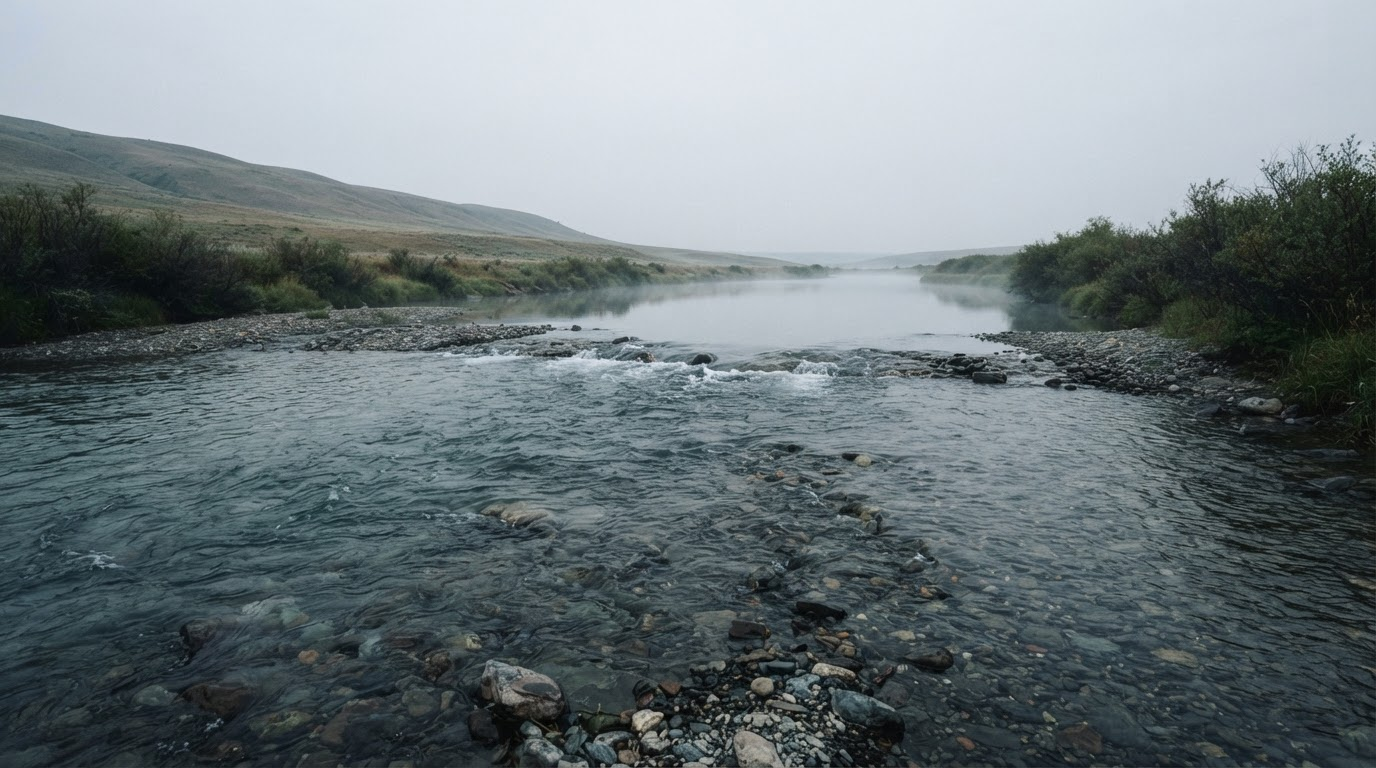
It's early spring, the water's in the low forties, and you have the run to yourself. You're doing everything right — good depth, clean mends, a drift with no drag on it. Nothing.
So you start changing. Pheasant tail. Smaller pheasant tail. Jig with a hot spot. Something with more flash, then something with less. Forty minutes and six flies later you're standing in the same water getting the same result, and you leave for lunch sure you don't own the right fly.
You come back around two, with four hours of sun on the water. Second drift, on the fly you tied at first light, a fish eats. Then another.
Nothing about the fly changed. The water came up four degrees.
Almost everyone reads a blank hour the same way: the fly is the one variable you can change with your hands, so the fly is what must be wrong.
It sounds right, and on a cold morning it is the most expensive thing you can believe. Whether a trout is eating at all gets settled before any of that.
when it's time to change flies
Every answer you've been handed comes in one of two shapes: fix the drift before you fix the fly, and change after some number of casts. The number is where it comes apart. Ask a room full of guides and you get nine guides, nine different thresholds, running from three or four casts to thirty or forty minutes. The more careful version is to fish the fly effectively first, which is right as far as it goes, but it still puts the pattern on trial.
Underneath all of it is a question about the fish, not the fly. Water temperature sets how fast a trout empties its stomach, and that sets how many meals it takes in a day. In a mountain stream holding both brown and rainbow trout, at mean temperatures of 4.7°C and 7.3°C — roughly 40 to 45°F — there was one night-time feeding window at 4.7°C, in the early hours of darkness, and what the fish took in barely covered the cost of existing.
Warm the same water and the day changes shape. At 10.8°C, call it the low fifties, a second daytime window at 10.8°C appeared — and now there's a fish on the clock while you're standing in the river.
So a cold morning is not a pattern problem. You can put the whole box down a good seam and it won't matter, because the trout you're presenting to isn't scheduled to eat until long after you've driven home. Water temperature answers that in ten seconds. Six fly changes answer nothing, and the forty minutes they cost you is forty minutes of the warming you were waiting on.
That leaves the sessions where the water is warm enough and something should be feeding. Then the fly is fair game — but only if you can read what actually happened on your last drift.
what the decision looks like on the water
The two branches on the right-hand side are the ones that decide whether the pattern is on trial at all.
how do I know if the fish even saw it?
Two different things happen when a trout doesn't eat, and they don't take the same fix. Either nothing moved, or something moved and turned away.
Trout aren't out there hunting for novelty. Watching cutthroat trout in a stream for ten days, water velocity was the main cue they used to choose where to feed — not what happened to be floating in it — and they were not thorough searchers. Food put a few metres off a fish's normal feeding position didn't reliably get found. A trout is a creature of one lane. If your fly went down a lane it isn't working, or a foot over its head, nobody rejected anything. It never got assessed.
This is where the standard sequence gets applied too widely. Common advice is to change nymphs after 10–20 casts without attention, giving an ignored fly and a refused fly the same remedy. The dry-fly version is tighter — kill the drag, drop a size, then change pattern, then rest the pool half an hour — and it works because a visible refusal is real information. The fish came, looked, and turned. Size, silhouette, or drag you can't see from where you're standing.
Ignored is a lane-and-depth problem: move your feet, get deeper, put the drift on the seam instead of beside it. Refused is a fly problem. Jim McLennan's framing is the one worth keeping — five or ten genuinely good casts beat the same bad one 250 times, and repositioning counts as changing something.
A fish that came up, looked, and turned away has earned you a fly change. What you reach for next is where most boxes let you down.